Archival Card Supplies: What Acid-Free Really Means
July 9, 2026 · 5 min read · By BGLAD
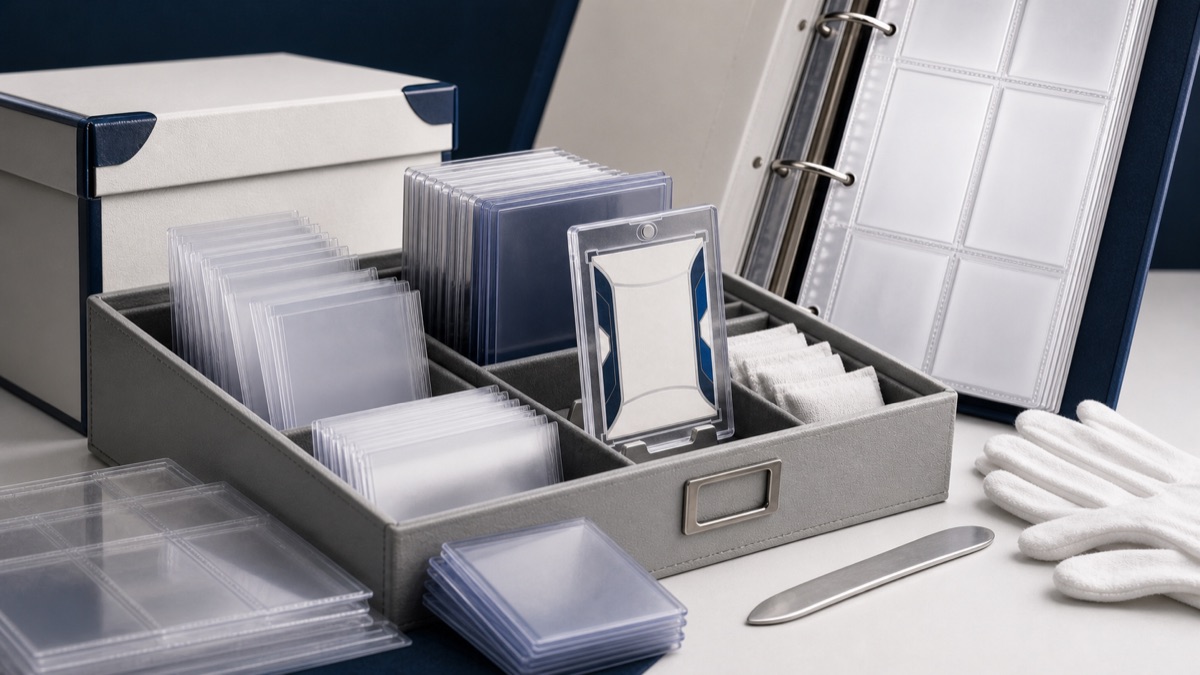
Archival card supplies are sleeves, holders, pages, boxes, mats, and storage materials chosen to reduce chemical damage, pressure, moisture, and handling over time. Acid-free and PVC-free labels are useful, but they are only part of the decision.
Collectors do not need the most expensive supply for every base card. We care about matching the supply to the card's value, fragility, storage time, and how often it will be handled.
Acid-free and PVC-free card supplies explained
Acid-free matters most with paper, board, mats, backing, boxes, and dividers. Acidic materials can discolor, weaken, or stain paper over time. For cards, tickets, photos, programs, and autographs, the material touching or near the collectible should not be ordinary cardboard, craft paper, or mystery backing.
PVC-free matters most with plastics. Soft vinyl materials can contain plasticizers that may migrate or leave residue, especially over long storage periods or in poor conditions. For card storage, collectors usually want stable plastics such as polypropylene, polyethylene, or polyester from reputable supply makers.
The label alone is not enough. A cheap sleeve can be PVC-free and still fit poorly. A box can be acid-free and still crush corners if it is overpacked. Use archival language as a starting filter, then judge fit, rigidity, clarity, and how the supply behaves in real use.
Sleeves, top loaders, and semi-rigid holder tiers
Start with the right sleeve. A sleeve should let the card slide in without force and should not pinch corners. Standard cards, thick relic cards, chrome cards, vintage odd sizes, and tall-boy issues may need different sizes. Forcing a card into the wrong sleeve is one of the easiest ways to create damage while trying to prevent it.
Top loaders are good for everyday protection, show boxes, and cards that need more rigidity than a sleeve. Semi-rigid holders are common for grading submissions and compact storage. One-touch holders can present a card nicely, but the fit must be right and the card should not rattle or press against the holder.
Whether a card came from a trade, a show, or one of our sealed boxes, the first supply decision should be boring and correct: sleeve it cleanly, choose the right thickness, and avoid pressure.
- Basic tier: penny sleeves, standard top loaders, team bags, and clean storage boxes for replaceable cards.
- Middle tier: premium sleeves, correctly sized thick-card holders, graded-card sleeves, and sturdier row boxes.
- Higher tier: one-touch holders, archival boxes, fitted cases, and professional framing for items that justify the cost.
- Wrong tier: any holder that requires force, traps moisture, smells strongly, scratches easily, or leaves residue.
Binders, pages, and boxes for long-term storage
Binders are convenient, but they need discipline. Use pages made for trading cards, avoid overstuffing, and store binders upright only if the pages are supported well. Heavy binders can sag, rings can press into cards, and loose pages can slide if the binder is handled carelessly.
Boxes are better for volume, especially when cards are sleeved and sorted. The risk is pressure from overfilling, corner contact from loose rows, and forgetting what is inside. Dividers, labels, and a basic inventory make boxes easier to use without constant digging.
Long-term storage should be stable, dry, and away from sunlight. Our guide to UV protection, framing, and cases covers light and display materials, while how to sort and catalog your collection helps keep supplies from turning into unlabeled piles.
When premium archival supplies pay off
Premium supplies pay off when the downside is meaningful. A scarce vintage card, a condition-sensitive foil card, a bold autograph, a ticket stub, or a family item deserves better materials than a common duplicate. The supply cost should make sense compared with the item's value and replaceability.
Premium also pays off when handling increases. Cards traveling to shows, being photographed, waiting for grading, or moving through consignment are exposed to more touches than cards sleeping in a box. Better fit and rigidity can reduce small mistakes.
Do not upgrade everything just because the packaging says archival. Upgrade the cards and memorabilia where better materials solve a real problem: chemical safety, rigidity, fit, light protection, moisture resistance, or cleaner organization.
- Upgrade for value: cards where a small condition change would matter financially or emotionally.
- Upgrade for fragility: vintage paper, autographs, tickets, photos, glossy surfaces, and thick memorabilia cards.
- Upgrade for movement: show inventory, grading candidates, travel cases, and cards being listed for sale.
- Upgrade for display: anything exposed to light, dust, frames, stands, or repeated viewing.
Common questions about archival card supplies
Are all penny sleeves archival? No. Many are fine for everyday card use, but you still want reputable, PVC-free sleeves that fit the card without pressure or cloudiness.
Is acid-free the same as PVC-free? No. Acid-free usually describes paper-based materials. PVC-free describes plastic materials. For a full storage system, both ideas can matter.
Do slabs need archival supplies too? Slabs protect the card, but the holder can still scratch, collect dust, or sit in a poor environment. Use graded-card sleeves, stable boxes, and the same climate common sense you would use for raw cards.
Ready to hunt?
Sports cards and collectibles — documented and carefully presented.